Debunking Water Filter Myths with Real Lab Data and Facts.
Many people trust branding or taste to decide safety. That assumption is risky because sensory cues rarely reveal invisible contaminants like PFAS or heavy metals.
This short guide begins with practical, science-based checks that separate marketing from measurable results. We use recognized standards such as NSF/ANSI 42 versus 53 and EPA limits to show why performance matters.

You will learn how to read performance sheets, utility Consumer Confidence Reports, and independent testing so you can match technology to actual problems. No single product solves every issue; matching treatment to contaminants is the only reliable route to better quality and health outcomes.
Expect actionable steps and a clear path to verify claims. Later, a call to action invites personalized help—email info@pureh2ohome.com for a consultation on your results.
Key Takeaways
- Not all claims are equal—NSF/ANSI 42 covers taste while 53 addresses health risks.
- Visible clarity or good taste does not guarantee absence of contaminants.
- Learn to read performance reports and utility or bottled water testing summaries.
- Match filtration technology to specific contaminants for reliable results.
- Independent standards and peer-reviewed science guide better decisions.
Why busting water filter myths matters right now
Understanding real limits and certifications matters today because trace contaminants persist in many supplies. WHO and the EPA note that treated municipal systems can still carry heavy metals, pharmaceuticals, microplastics, and chlorine byproducts. USGS reporting also shows PFAS are widespread in U.S. tap water.
Timely correction of common myths protects health. Persistent threats such as PFAS, DBPs, and lead can remain in public water and private wells despite routine treatment. Private wells are not covered by the Safe Drinking Water Act, so owners must test and act.
People who assume safe supply based on taste or brand delay needed upgrades. That delay increases exposure and raises long-term risks.
“Reading your Consumer Confidence Report and matching certifications to measured problems saves money and lives.”
- Benefits of acting now: safer drinking for families, smarter investment in systems, and reduced health risk.
- Next steps covered later: get a certified test, interpret certifications like NSF/ANSI, and choose a system that fits your results.
How to use lab standards and guidelines to vet any filter claim
Start by matching standards to the contaminants you actually measure at the tap. Use certificates and performance sheets to turn marketing into measurable expectations.
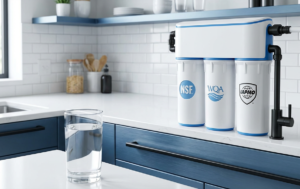
NSF/ANSI 42 covers aesthetic reductions such as chlorine taste, odor, and particulate control. NSF/ANSI 53 targets health-related contaminants like lead and specific VOCs and pesticides.
EPA guidance and real limits
The EPA notes that some contaminants need specific technologies. No single system removes every class of contaminants. Confirm which levels a product was tested against before you buy.
Read performance sheets like a pro
Look for influent and effluent levels, percent reduction, capacity, flow rate, and replacement interval. Check test conditions — pH, temperature, pressure, and contact time affect real-world performance.
“Certifications require third-party testing under standard conditions; marketing claims do not.”
- Verify model and certificate numbers on packaging.
- Keep test reports and re-test dates for future comparison.
- Use those standards to compare systems and avoid paying for features you don’t need.
Debunk water filter myths lab data
Marketing slogans often claim total removal, but certifications define narrow, testable scopes.
Myth: “All filters remove 100% of contaminants” — what certifications really prove
All filters remove 100% of contaminants is a dangerous myth. NSF/ANSI 42 covers aesthetic reductions such as chlorine, taste, and odor. NSF/ANSI 53 addresses specific health-related contaminants like lead.
Neither certification guarantees removal of every chemical or class of contaminant. Always check the certified list of tested compounds before you buy.
Myth: Boiling makes any water safe — why chemicals and metals remain
Boiling kills microbes, but it does not remove inorganic contaminants like heavy metals, salts, or many chemicals. Evaporation can concentrate some contaminants.
Myth: Taste and smell equal safety — the danger of invisible contaminants
Pleasant taste or no odor is not a fact of safety. Lead, many PFAS, and arsenic are tasteless and odorless.
| Method | What it reduces | Limitations |
|---|---|---|
| Single-stage carbon | Chlorine, some VOCs | Not reliable for PFAS, lead, DBPs |
| NSF/ANSI 53-certified units | Specific health contaminants (e.g., lead) | Tested list only; capacity matters |
| Boiling | Microbes | Does not remove heavy metals or many chemicals |
- Fact: Match technology to measured contaminants and verify certificates.
- Plan periodic retesting and timely cartridge replacement to keep performance on-spec.
Tap water reality check: Public water, private wells, and present-day risks
Tap systems and private wells face different risks today. Know which applies to your household so you can act on real threats.

PFAS, lead, and DBPs: What studies and utility reports reveal
Recent surveys show at least 45% of U.S. tap water contains one or more PFAS compounds. Lead can persist in pipes and fixtures, and experts agree no amount is safe for children.
Disinfection byproducts form when chlorine reacts with organic matter. They may not affect taste yet still raise health concerns at certain levels.
Why “treated” doesn’t always mean contaminant-free at the tap
Public water systems reduce many risks, but source pollution, distribution lines, and plumbing can reintroduce issues. Private wells are not covered by the Safe Drinking Water Act and need owner testing and plans.
- Check your Consumer Confidence Report (CCR) and follow up with a certified test tailored to your area.
- After storms, construction, or seasonal shifts, reassess results and adjust treatment choices.
- In agricultural zones, pesticides and industrial metals may need targeted solutions.
“Interpret utility reports and independent tests together to choose a system that matches measured contaminant levels.”
Bottled water vs filtered tap water: Marketing vs measurable quality
Bottled brands promise safety and taste, yet measurable contaminants sometimes appear in independent checks. Consumer Reports found PFAS in several popular bottled products, and one study detected microplastics in about 93% of samples.
PFAS, microplastics, and reporting gaps
Public water systems must test often and publish results. Bottled producers face looser, less transparent rules from the FDA. That means branded claims do not always match measurable outcomes.
Cost, waste, and the smarter switch to certified home filtration
- Contaminants: Tests show PFAS and microplastics in some bottled sources; plastic can leach chemicals after heat or long storage.
- Cost and waste: Bottled water adds plastic and higher per-gallon expense versus an on-site certified option.
- Efficiency: RO can waste up to 4 gallons per 1 gallon in older setups, but modern systems and pressure-independent designs cut waste and improve performance.
- Taste and quality: Carbon stages improve taste on demand without transport or single-use bottles.
Bottom line: For most people, reallocating a bottled budget to a certified home system gives better traceability, less waste, and consistent drinking quality at the tap. Consider models certified for your measured contaminants and check pressure and efficiency specs before purchase.
TDS confusion solved: Why “good” TDS isn’t proof of clean water
A low TDS reading can feel reassuring, but the number alone hides what actually sits in your tap.

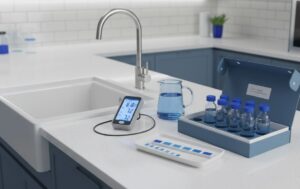
TDS meters measure total dissolved solids, not identity. That means a single number cannot tell you which metals or chemicals are present or their toxicity.
Uncharged molecules, including some pesticides and PFAS, won’t register on a TDS meter. Low readings can still coincide with harmful contaminants at concerning levels.
- High TDS may reflect harmless minerals or harmful heavy metals — the number alone is ambiguous.
- Two homes with similar TDS levels can require very different treatments based on specific contaminant profiles.
- Use TDS as a maintenance indicator (for example, RO membrane performance), not as a safety certificate.
Do a certified lab test to identify contaminant names and concentrations before choosing a treatment path. Match results to NSF/ANSI certifications and verified performance sheets.
“Verified reductions of health-relevant contaminants matter far more than a single meter reading.”
Fridge and pitcher filters: Where they help and where they fall short
Simple carbon stages in pitchers and fridge lines improve everyday taste, but they have clear technical limits for tougher contaminants.
What single-stage carbon does well: Most pitchers and refrigerator cartridges use activated carbon to reduce chlorine taste and some organic compounds. That improves flavor and makes tap water more appealing for drinking and cooking.
Limits of single-stage cartridges
These small cartridges rarely remove PFAS, lead, DBPs, or many pesticides. Capacity, contact time, and flow rate in compact units limit real-world performance.
Replace cartridges on schedule. When capacity is exceeded, reductions drop sharply and claimed performance no longer applies.
When to upgrade
If your test results show PFAS, heavy metals, or other health-relevant contaminants, step up to multi-stage systems or reverse osmosis. Combining carbon stages with RO or specialty media covers both taste and health risks when each stage is certified.
- Check: NSF/ANSI certifications and Performance Data Sheets, not marketing copy.
- Use: Keep the fridge or pitcher for convenience, but add a certified under-sink system for drinking and cooking.
- Maintain: Set calendar reminders to replace cartridges before capacity limits are reached.
“Convenience is useful, but matching technology to measured contaminants protects health and performance.”
Reverse osmosis, carbon, and softeners: Matching technology to contaminants
Good system design begins with a mapped approach: what contaminant, which technology, and where to place it.
Reverse osmosis excels at reducing dissolved solids and many heavy metals. Use RO for high TDS, lead, and similar ions when the goal is highly purified drinking water.
RO for dissolved solids and metals; carbon for chlorine and VOCs
Carbon stages target chlorine, taste, odor, and many VOCs. They are ideal as pre- or post-treatment to improve taste and protect RO membranes.
Reverse osmosis paired with carbon gives both broad contaminant reduction and better taste. Check certifications to confirm which specific contaminants each stage removes.
Water softeners: Comfort, scale protection, and common myths in context
Softeners remove hardness minerals like calcium and magnesium. That saves appliances and prevents scale buildup across the home.
Softened water is safe for most people. The “slippery” feel simply means cleaner rinsing, not a health hazard. Note: softeners do not remove PFAS, lead, or pesticides; they are not a substitute for targeted treatment.
- Match technologies: RO for dissolved solids and metals; carbon for chlorine and VOCs; softeners for hardness.
- Combine wisely: Many households pair a softener for whole-home comfort and an RO or certified multi-stage system at the tap.
- Plan maintenance: Size systems for household flow and follow replacement schedules to keep performance within spec.
“Start with your test results, then phase upgrades: treat the highest-risk contaminant first and expand as needed.”
Energy, water use, and waste: The real performance picture
Household treatment systems differ sharply in their energy needs, waste streams, and real-world performance.
Do filters “use too much electricity”? Most home units use little or no power. Gravity and line-pressure designs need no electricity. Powered units often draw about 35–70 watts, which translates to only a few dollars a month in typical use.
Reverse osmosis systems are commonly cited for waste. The EPA notes older RO setups can produce up to 4 gallons of reject for every gallon produced. Modern membranes, permeate pumps, and pressure-optimized designs cut that ratio substantially.
Real efficiency considerations
- Energy: Typical powered units use far less energy than a refrigerator or microwave per day.
- Waste: RO efficiency depends on line pressure, temperature, and feed chemistry; low pressure raises reject rates.
- Maintenance: Timely membrane and prefilter replacement preserves performance and reduces waste over the system life.
- Monitoring: Track flow rate and TDS as simple proxies to spot declining efficiency.
Compare lifecycle impact: bottled options add transport and packaging energy per gallon, often far exceeding home systems’ operating footprint.
“Choosing the right size and technology, and keeping parts fresh, saves energy and cuts unnecessary waste.”
Bottom line: Energy use and waste are manageable. Pick modern RO designs or pressure-fed technologies and follow maintenance schedules to optimize life-cycle performance.
Step-by-step: How to test your water and choose the right system
Start smart: a clear plan makes testing and selection efficient and cost-effective.
Begin with a state-certified laboratory test to identify specific contaminants and their exact levels. Then pull your utility’s Consumer Confidence Report (CCR) to see which regulated contaminants appear in your area and typical seasonal trends.

Match results to certification targets
Translate measured levels into certification needs. Choose NSF/ANSI 53 for lead and many health-related compounds and NSF/ANSI 42 for chlorine taste and odor. Use other standards when tests show niche contaminants.
Pick the right system type
Decide between point-of-use and whole-home systems based on where contaminants pose the biggest risk. Consider osmosis-based systems for high TDS and metals, pairing them with carbon stages to handle taste and organics.
Plan installation and maintenance
- Size the system for household flow and peak demand.
- Track cartridge and membrane capacity in gallons or months and set calendar reminders.
- Verify pressure and temperature requirements at the install site to keep certified performance.
- Document model numbers, certification listings, and performance sheets for future audits.
“Test first, match technology to measured levels, and maintain on schedule to keep safe drinking results.”
Re-test after major plumbing work, flooding, or seasonal shifts to confirm the chosen treatment still meets your goals and offers lasting protection.
Get expert help: Myth-busting consultations based on your water quality
An expert review translates technical reports into simple actions that improve safety and taste at the tap. Email info@pureh2ohome.com to have specialists review your test results, certificates, and performance sheets.
Consultants will interpret your report, explain NSF/ANSI scopes, and recommend a system matched to household priorities and area conditions. They compare verified performance and certification listings rather than marketing claims.
- Personalized review of local tap conditions and measured contaminants.
- Mapping contaminants to certification-backed solutions for home use.
- Guidance on combining systems and on maintenance schedules to preserve performance and safety.
| Service | Benefits | Expected outcome |
|---|---|---|
| Report interpretation | Clear priorities | Targeted system selection |
| Certification review | Verified performance | Reduced risk and better quality |
| System fit & cost review | Optimized budget | Lower total cost of ownership |
| Maintenance plan | Consistent performance | Long-term safety |
“Contact info@pureh2ohome.com for a practical, certification-focused consultation that turns test results into an actionable plan.”
Conclusion
Choose systems that match measured risks at your tap, guided by certificates and reports. Trust certification and utility results over marketing or taste when you pick solutions for your home.
Strong, certification-backed choices give safer drinking results, cut unnecessary waste from bottled water, and improve everyday life. Single-stage carbon helps taste and odor but does not solve all health threats.
Match technology to need: carbon for chlorine and VOCs, RO for dissolved solids and metals, softeners for scale, and specialty media when required. Keep parts fresh and verify performance over time.
Take a small step now to gain long-term benefits. Email info@pureh2ohome.com for tailored help and get reliable, certified protection for your family’s health and home day after day.