Water Filter Certifications Explained: NSF, WQA, and IAPMO Guide
Can you tell which mark on a product truly proves it reduces lead or PFAS, not just marketing copy?
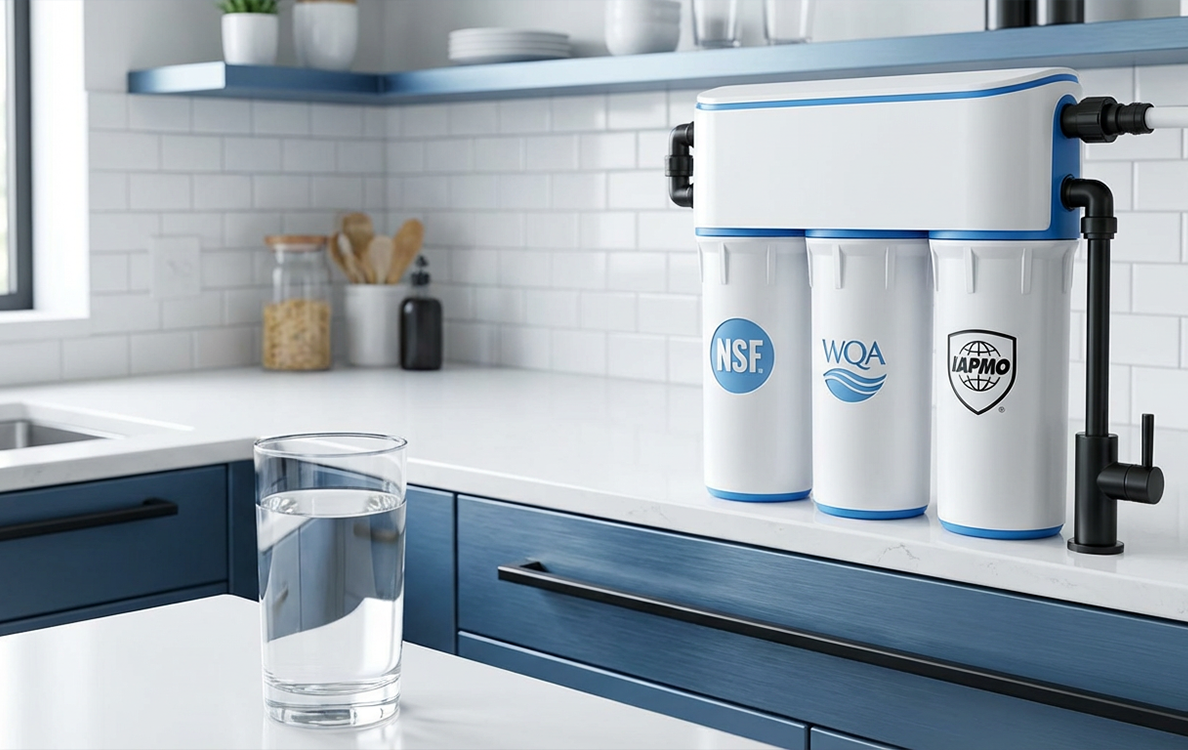
This short guide clears up how third‑party programs test and verify claims for drinking safety and taste. Independent bodies test products to the same NSF/ANSI benchmarks—most often 42, 53, and 58—so the logo matters less than the exact standard listed.

Certification validates contaminant challenge testing, materials safety, structural checks, and factory audits. It typically renews yearly and can be costly—complex product approval may run $100,000–$200,000 plus ongoing fees, costs often reflected in product pricing.
Use aesthetic standards like ANSI 42 for chlorine taste, health standards such as ANSI 53 for lead, and ANSI 58 for reverse osmosis systems. WQA S-200 and IAPMO R&T add performance and plumbing safety context for installations subject to code.
For tailored, certified recommendations matched to your water report, contact info@pureh2ohome.com.
Key Takeaways
- Third‑party programs follow the same NSF/ANSI test methods, so check the standard and contaminant claim.
- NSF/ANSI 42, 53, and 58 are the common standards tied to aesthetic, health, and RO claims.
- Certification is contaminant‑by‑contaminant; “certified to” is stronger than “tested to.”
- Complex certifications are expensive and can affect product price but matter most for lead, PFAS, and health risks.
- RO systems with ANSI 58 suit mixed contaminant concerns; basic carbon solutions often address taste and odor.
- For personalized advice based on a water report, contact info@pureh2ohome.com.
Why water filter certifications matter for safe, great‑tasting drinking water
Formal approval confirms a device cuts specified contaminants while keeping flow and material safety for its rated capacity.
Independent validation gives consumers peace of mind. Third‑party testing verifies contaminant reduction percentages under controlled challenge tests and over the system’s rated life. It also checks that materials are safe for drinking water contact and that structural integrity and flow meet performance claims.
Because EPA and FDA do not regulate most home treatment devices, publicly searchable listings are vital. Annual renewal helps ensure ongoing compliance as materials or suppliers change.
- NSF/ANSI 42 ties to taste and odor; 53 covers health risks like lead, PFAS, and cysts; 58 applies to reverse osmosis systems for multi‑contaminant reduction.
- Test protocols simulate real use, ensuring reduction targets and flow are maintained across the rated capacity.
- Certified products often include clearer installation, maintenance, and capacity labels that support predictable performance and family safety.
| Standard | Primary Focus | Typical Reduction Claims |
|---|---|---|
| NSF/ANSI 42 | Taste & odor | Chlorine, particulates, aesthetic issues |
| NSF/ANSI 53 | Health risks | Lead, VOCs, PFAS, cysts |
| NSF/ANSI 58 | Reverse osmosis performance | TDS reduction, broad contaminant control |
If you aren’t sure which standard fits your needs, contact info@pureh2ohome.com for certified product recommendations tied to your local report and household priorities.
water filter certifications NSF WQA IAPMO: who they are and how they compare
Three accredited organizations each verify product claims using the same test methods, but they bring different strengths to manufacturers and buyers.

NSF International
NSF developed many of the nsf standards in common use and enjoys broad consumer recognition. Its name is often the first one shoppers see on labels and retail listings.
Water Quality Association (WQA)
The water quality association (founded 1974) runs the Gold Seal program and offers the WQA S‑200 performance standard. Manufacturers value WQA for industry connections and product support.
IAPMO R&T
IAPMO (est. 1926) operates IAPMO R&T with deep ties to the international association plumbing and the association plumbing mechanical community. Its listings help when code officials or mechanical officials require code‑related compliance.
Equal rigor, different logos
All three bodies test to the same nsf ansi protocols, so equivalence rests on the standard number and specific contaminant claims—not the mark. Listings and performance data sheets in each public directory let buyers confirm model numbers and reduction claims.
- Check the exact standard and contaminant line‑items on a product’s Performance Data Sheet.
- Expect annual recertification to keep materials, testing, and factory audits current.
Key NSF/ANSI standards buyers should know: 42, 53, and 58
Buyers should focus on three key standards—42, 53, and 58—to match claims to common household concerns.
NSF/ANSI 42: aesthetic effects
NSF/ANSI 42 targets taste, odor, and clarity. It covers chlorine and chloramines, particulate removal, and some metals like iron and manganese.
This standard helps improve drinking taste and can extend appliance life by reducing sediment and odor.
NSF/ANSI 53: health protections
NSF/ANSI 53 focuses on health risks. Common listed claims include lead, VOCs, asbestos, cysts, PFAS, and chromium.
Choose products certified under this standard when older plumbing or local contamination concerns exist.
NSF/ANSI 58: reverse osmosis performance
NSF/ANSI 58 applies to point‑of‑use reverse osmosis systems. It requires baseline TDS reduction and can validate specific claims for nitrate, arsenic, radium, and fluoride.
Scope matters
Standards are granted for specific contaminants, not a blanket list. A product “certified to 53” may cover only lead and cysts.
- Compare Performance Data Sheets and online listings to confirm exact claim line items.
- Standards also check materials safety and structural performance in addition to reduction targets.
- Municipal users often start with 42 and selective 53 claims; well users may need broader 53 coverage or an RO system under 58.
How certification works from lab to label—and how to verify a product
A product’s journey from claim to public listing depends on detailed paperwork, strict testing, and site inspections.
The path to approval: application, materials review, testing, and factory audits
Manufacturers begin with an application that lists claimed reductions, formulations, and factory locations. Labs run structural, flow, and contaminant challenge testing to confirm real‑world performance.
Reviewers also check labels, manuals, and Performance Data Sheets for accurate claims. Inspectors visit factories to verify quality control and mark usage.

Reading the seal and online directories
Look for authentic marks on labels, manuals, and product stickers. Use certifier directories—including WQA S‑200 and IAPMO R&T listings—to confirm model numbers and scope.
“Certified to” vs “tested to”: what it means for you
“A listed product has ongoing audits; a tested result may be a one‑time lab report.”
Certified to means public listing and annual audits. Tested to can mean lab results without directory listing or factory inspections. For verification, capture the model, check the certifier’s database, confirm exact standards (for example nsf ansi entries), and save the Performance Data Sheet.
- Record model number and batch if present.
- Search the certifier directory and confirm standards and contaminant line items.
- Verify status and renewal date; renewals typically happen yearly.
Choosing the right filtration: match standards to water source and contaminants
Match your treatment choices to the source and measured contaminants for the best outcome.

Municipal vs. private well: where to focus
Municipal supplies often require systems tuned for taste and chlorine control first. Start with ANSI 42 for aesthetic gains, then add targeted ANSI 53 claims if your utility report lists lead, VOCs, or PFAS.
Private wells usually need health-focused protection. Prioritize ANSI 53 for arsenic, lead, cysts and consider reverse osmosis (ANSI 58) when multiple contaminants or unknowns are present.
Smart value: balance costs, performance, and upkeep
Certification adds trust, especially for serious health risks or complex verification. But basic sediment and carbon stages can deliver strong real-world results without costly listings.
- Match Performance Data Sheets to your lab results; don’t assume coverage beyond the listed claim.
- Factor in lifespan, flow, replacement cadence, and consumable costs when comparing products and systems.
- Pair certified health stages with affordable pre‑treatment to optimize budget and reduction performance.
“Invest where health risk or verification uncertainty is high; save on proven pre‑filters.”
Want tailored advice? Email your latest test or utility report to info@pureh2ohome.com for system recommendations and a cost‑benefit review.
Plumbing safety and code confidence: the role of IAPMO R&T and product listing
IAPMO R&T connects product listings to building codes so installers and officials can confirm compliance at a glance.
Founded in 1926, the international association plumbing arm brings plumbing mechanical expertise to certification. It certifies devices to nsf ansi standards, so contaminant reduction rigor matches other bodies while adding code‑centric listing benefits.
Inspectors and plumbing mechanical officials use model‑specific entries for permitting, warranty proof, and insurance paperwork. Saved directory pages speed inspections and prevent rework.
Manufacturers often pick IAPMO for efficient alignment with plumbing requirements and for its familiarity with local mechanical officials. That practical focus helps in multi‑family and commercial projects where documented compliance accelerates approvals.
“Print or save the directory entry to show code conformance during inspection.”
- Listings show both performance standards and installation safety requirements.
- Plumbing safety complements contaminant claims—confirm both for full confidence.
- Check annual listing renewals to avoid delays at inspection or permitting.
Conclusion
Focus on the exact ANSI standard and listed contaminants to separate marketing from verifiable performance.
In short: ANSI 42 targets taste and odor; ANSI 53 covers health risks like lead and PFAS; ANSI 58 applies to reverse osmosis and broad TDS reduction. The water quality association S‑200 and IAPMO R&T listings provide equivalent validation when they reference the same ANSI standards. Annual renewals and public listings make claims checkable.
Choose based on risk: municipal users often start with 42 for taste, add 53 claims as needed; private wells or health concerns usually point to 53 or RO under 58. Save directory entries for inspections and warranty proof. Prefer “certified to” over “tested to” for verified reduction and ongoing audits.
Need help? Email your report to info@pureh2ohome.com for a short list of certified products matched to your home and budget.



This website online can be a stroll-by means of for all of the info you wished about this and didn’t know who to ask. Glimpse right here, and also you’ll positively uncover it.
Thank you for the kind feedback! I’m glad the website helped you find the information you were looking for.